

The Queensland property market is entering a period of change that many in the industry have not yet fully priced in.
With updated land valuations flowing into 2026, a significant number of residential investment properties will move further above land tax thresholds. For many investors, this will result in material increases in holding costs — in some cases, well beyond standard inflation.
This is not yet fully reflected in market behaviour.
But it will be.
What This Means for Agents and Property Managers
In residential real estate, seller motivation typically falls into two categories:
- Lifestyle-driven decisions
- Financial pressure
Land tax sits squarely in the second category.
Unlike commercial property, where most outgoings are recoverable, residential investors operate in a more constrained environment. Increased holding costs are not always fully passed through to tenants, particularly in competitive or regulated rental markets.
This creates a predictable set of outcomes:
- Investors reassess portfolio performance
- Holding costs begin to influence decision-making
- Some investors increase rents where possible
- Others consider divestment
These shifts rarely happen all at once — but they do happen progressively, and often quietly at first.
Where the Opportunity Lies
For agents and property managers, this presents a timing advantage.
Most investors have not yet fully connected:
- land tax increases
- total holding cost pressure
- and their medium-term property strategy

Agents who understand this dynamic early are in a position to:
1. Open More Meaningful Conversations
Rather than generic check-ins, discussions can be anchored around:
- changing holding costs
- portfolio performance
- forward planning
This moves the conversation from transactional to advisory.
2. Identify Emerging Sellers Before They List
Investors under financial pressure don’t always act immediately — but they do start thinking differently.
Early engagement allows agents to:
- identify intent before it becomes public
- position themselves as the trusted contact
- secure future listings ahead of competitors

3. Support Property Management Growth
For property managers, increased holding costs often lead to:
- rent reviews
- yield reassessment
- closer client engagement
The benefits are multiplied: the mention of Land Tax campaign can only reinforce the value of professional management, strengthen landlord relationships, support justified rental adjustments and assist the industry as a whole.
4. Build a More Engaged Client Database
Clients respond to information that is directly relevant to their position, and the costs associated with owning residential property investment, are being increased by Government through rates and particularly Land Tax based on rubbery figures that provide the excuse to raise taxes and rates.
A Practical Way to Start the Conversation
One of the simplest ways to introduce this topic is by referencing real, structured input from the market.
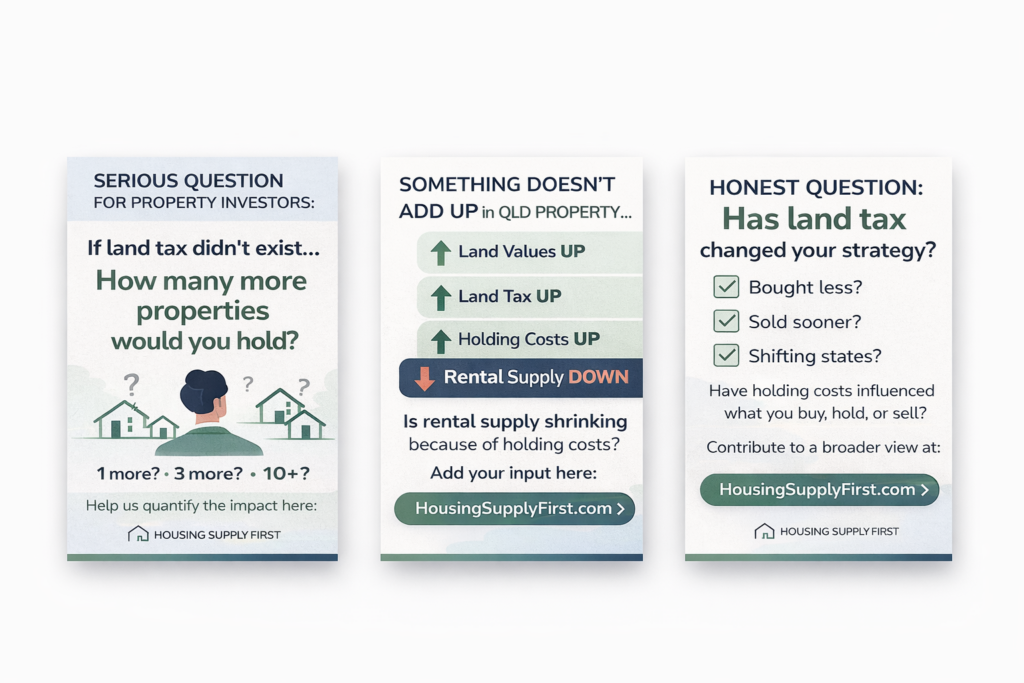
The Housing Supply First initiative is currently collecting direct feedback from investors and industry participants on how land tax and holding costs are influencing behaviour with residential investors. Ultimately, we need to have the Government reduce or eliminate tax on residential rental property ownership.
Housing Supply First
Agents can use this as a neutral entry point:
- share the link with clients – either directly in discussion or broadcast email.
- ask for their perspective and encourage them to visit the campaign page online.
- use it to frame broader discussions and discover things that may lead to sales or management.
Housing Supply Alliance
This is not about advocacy or positioning — it is about:
- understanding market sentiment
- engaging clients with relevant information
- staying ahead of behavioural shifts
Positioning Matters
It is important that conversations around land tax are handled carefully.
The objective is not to:
- take a political position
- or challenge policy directly
But rather to:
- understand its commercial impact – get educated about the impacts of costs on rental investments
- support clients in navigating changing conditions – knowledge is power
- provide informed, relevant guidance – referrals, sales and leasing presentations and ongoing dialogue build relationships
Agents who approach this in a measured, professional way will strengthen their credibility — not risk it.
Looking Ahead
The key takeaway is simple:
Holding costs influence behaviour — and behaviour drives transactions.
As land tax settings begin to flow through into real-world investor decisions, those who are prepared will be better positioned to:
- identify opportunities earlier
- support clients more effectively
- and grow both sales and management pipelines
Final Thought
This is not a short-term tactic, but its playing out right now in the market. This shift will become visibly obvious (and exposed in the msm media) by August 2026.
It is an early signal of a broader shift and residential investment property will become one of the main listing categories in months ahead.
Agents who recognise and act on that signal now will be operating ahead of the market.
Calculate Land Tax in Queensland and NSW – Click here