

If Government Wants More Housing, Why Tax the People Providing It?
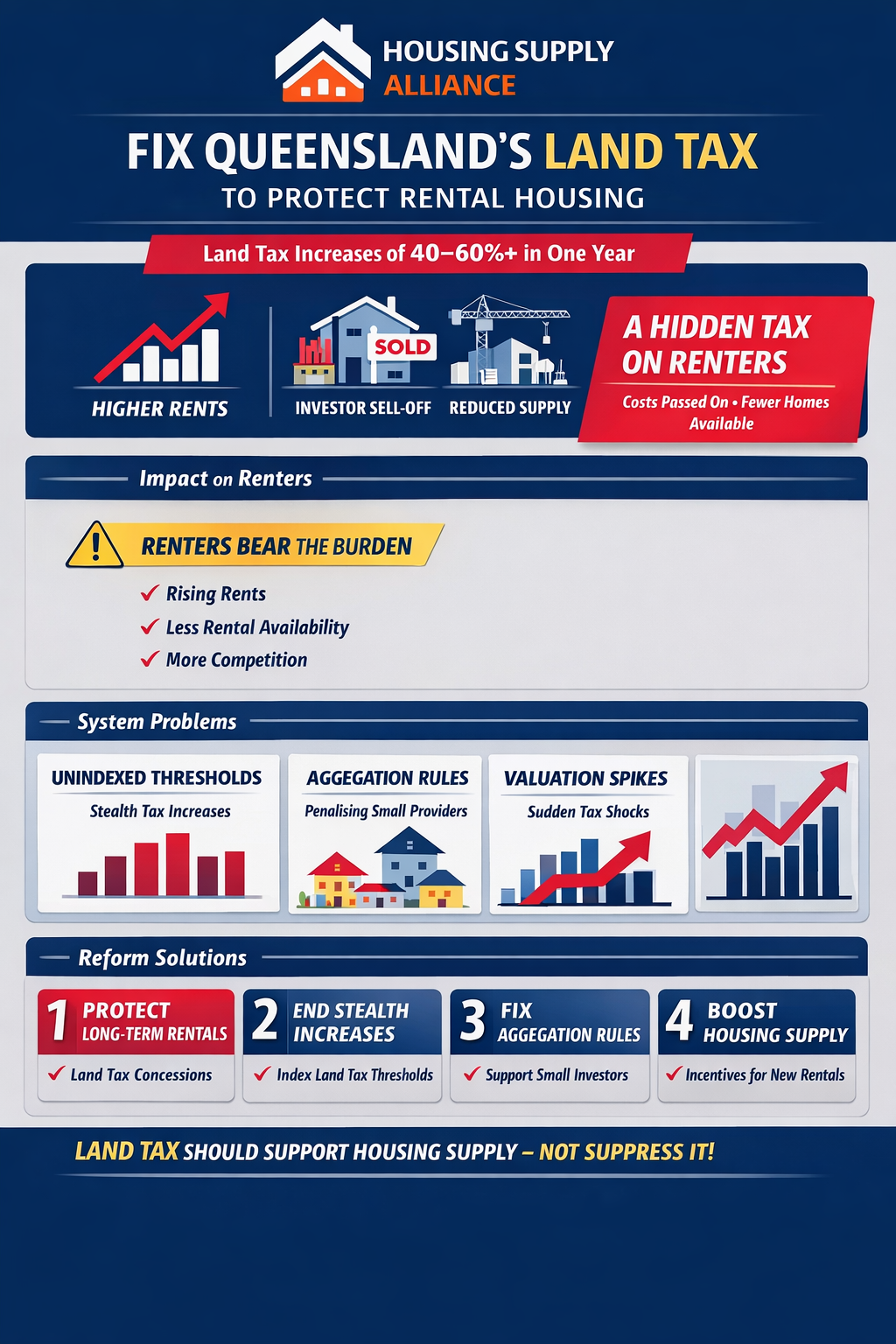
Land tax notices have arrived. For many Queensland property owners, the numbers are confronting — with annual increases of 15%, 18%, 30%, 40% and even 45% being reported. The obvious question is: how does making rental housing more expensive help Queensland afford more housing?
“Queensland property investors are facing another increase in the cost of providing rental housing.”
There is a bigger issue here than another tax bill.
Queensland is in the middle of a housing shortage. Rents remain under pressure, construction costs are elevated, development feasibility is difficult and governments at every level are talking about the need to increase housing supply.
Yet the policy settings continue to make it more expensive to own, develop and hold residential property for rent. Could the Govt be seeking to reduce their competition? This is part of the contradiction addressed in the following post.
The August 2026 land tax shock
Land tax assessments being received by Queensland property owners in August 2026 are bringing home just how quickly the holding cost of residential property can change.
For some owners, the increase is relatively modest. For others, the increase is substantial.
Reports of annual increases in the order of 15% to 18%, and in some cases 30%, 40% or even 45%, are enough to materially change the economics of an investment property. That matters because land tax is not an isolated cost. A rental property already carries interest, insurance, council rates, maintenance, repairs, property management, compliance costs and vacancy risk.
Add another significant increase in land tax and the owner has only a limited number of choices:
- absorb the additional cost;
- increase the rent where the market allows;
- sell the property;
- delay purchasing another property;
- or abandon a proposed development.
None of those outcomes automatically creates another dwelling. In fact, some of them can reduce the supply of rental housing.
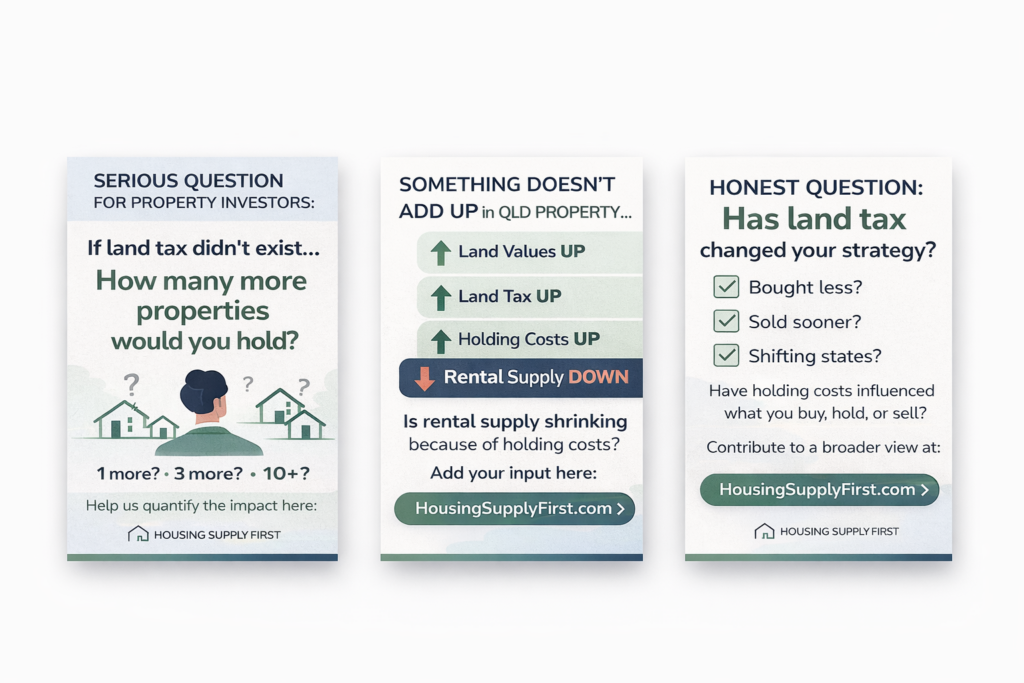
The Housing Supply First campaign in Queensland has been collecting real-world data from investors, property managers, accountants and developers to document precisely these effects. The campaign describes the issue as one of rising costs, shrinking supply and increasing financial pressure on renters and landlords.
This is not just an investor issue
If the cost of doing that increases materially, the economics change. Ultimately, the person who occupies the property is part of that economic equation.


There is a temptation to dismiss land tax as simply a tax on property investors. That misses the point. A large proportion of the private rental market exists because someone is prepared to buy and hold residential property and make it available to a tenant.
This does not mean every dollar of additional land tax can simply be added to the rent. Rental markets don’t work that way. Tenants have limited capacity to pay and landlords cannot charge whatever they like. The RTA in Qld restricts rent increases to annual rises, and what the tenant may consider excessive, can be challenged through a tribunal.
But the cumulative effect of increasing holding costs causes a trade off. It makes no economic sense to continually absorb increases in Govt fees, taxes and charges, since this erodes investment profit, which on residential is barely 2-3% in most capital and regional markets. Operating costs now account for approximately 45% of revenue on a residential investment, and that does not include mortgage repayments!
- A property that was marginally viable yesterday can become unattractive tomorrow.
- Rents that look strong on paper provide less than attractive profits after all expenses and stress are calculated.
- A property that was going to be purchased and renovated may instead be sold.
- A small development that looked feasible on paper may be delayed.
- And an investor who was considering buying another dwelling may decide that the additional tax and regulatory burden simply isn’t worth it.
It becomes quite straightforward: land tax should be linked to increasing housing supply, not worsening it.
The four questions Government should be asking
The current land-tax debate should come back to four very simple questions.
1. Does the tax encourage more rental housing or less?
If the objective is increased housing supply, policy should reward the people and businesses that provide housing — particularly where that housing is made available to the long-term rental market.
A tax that increases the cost of holding rental property works in the opposite direction.
Queensland already recognises this principle in other areas of housing policy. Build-to-rent developments, for example, can qualify for a land-tax concession subject to specific conditions, but foreign investment firms are treated better than Qld investors.
So the principle is already accepted:
If you provide housing, Government can choose to reduce the tax burden, or manipulate it to benefit larger players.
The question is why that principle should be restricted to particular large-scale investment structures rather than being applied more broadly.
2. What happens to the rental property when the numbers no longer work?
The Housing Supply First campaign asked owners to report whether increased land tax has resulted in them holding, considering a sale, selling or delaying development. That is important data. Government should not rely solely on theoretical modelling when it can ask the people actually paying the bills.
If hundreds or thousands of property owners independently make the same decision — “I won’t buy another one”, “I’m going to sell”, or “the development no longer stacks up” — that is a housing-supply issue that weakens the economy.
3. Why are we making Australian residential investors carry a heavier policy burden?
The current debate becomes particularly difficult; when an Australian citizen who owns a residential investment property and makes that property available to a Queensland tenant is contributing rental accommodation to the market is not given the same opportunities:
- They are not necessarily a large institutional investor.
- They may own one property.
- They may own two.
- They may be a couple building retirement assets, a small business owner, a tradesperson or someone who has simply chosen residential property as part of a long-term investment strategy.
The policy question should not be whether every investor deserves a tax concession, the question should be:
Does the tax system distinguish fairly between capital that contributes to housing supply and capital that does not?
Queensland already has special arrangements relating to foreign investment. Foreign companies and trustees of foreign trusts can face a 3% foreign land-tax surcharge, while the State also provides specific concessions and administrative arrangements intended to encourage certain forms of foreign residential development and build-to-rent investment. That demonstrates that Government is prepared to modify the tax system when it believes doing so can influence investment and housing supply.
So why shouldn’t the same supply-first principle apply to Australian citizens providing ordinary residential rental housing?
At an absolute minimum, Australian residential investors should not be placed at a policy disadvantage compared with international or foreign capital when both are contributing rental housing to Queensland.
4. Is the objective revenue — or housing?
Perhaps the most important question is; what is the priority – revenue or housing?
Land tax is a source of State revenue. That is understood. But governments cannot simultaneously declare that Queensland desperately needs more housing and then prioritise tax over housing the public. They seem to ignore the effect of taxation on the economics of supplying that housing.
Planning charges, infrastructure charges, stamp duty, land tax, construction costs, finance costs and compliance requirements all feed into the feasibility of a residential project.
If the combined effect is to make projects harder to finance and rental properties more expensive to hold, then the policy environment is not neutral. It is influencing supply, and in a housing shortage, that matters.
A better solution: put housing supply first
Here’s a relatively simple principle that could change the conversation.
If a property is genuinely providing residential rental housing, why should the land beneath it attract land tax at all?
A housing-supply-first policy could provide a land-tax exemption for property that is genuinely being used to provide long-term residential rental accommodation. The principle would be simple:
No land tax on land being used to provide residential rental housing.
There would, of course, need to be sensible safeguards. The exemption could be linked to genuine residential tenancy arrangements, minimum occupancy requirements and appropriate evidence that the dwelling is actually being made available to the rental market.
- Vacant land would not automatically qualify.
- Speculative holdings would not automatically qualify.
- A holiday home would not automatically qualify.
- But a house, townhouse, unit or qualifying residential development that is genuinely providing a home to a tenant would.
That would change the incentive, and instead of Government saying, “The more residential property you hold, the more tax you pay,” the message becomes: “If you provide more housing, the tax system will not penalise you for doing so.”
This aligns much closer to a housing policy.
Why not test the idea?
Queensland does not need another housing strategy full of targets, committees and announcements. It needs policies that change behaviour:
- If the State wants more rental housing, remove a cost associated with supplying rental housing.
- If the State wants more dwellings constructed, reduce the holding costs that make development harder.
- If the State wants more private rental accommodation, stop treating the people who provide it as though they are simply a convenient source of additional revenue.
- And if Government wants institutional and foreign capital to participate in housing supply, Australian citizens providing the same essential service should not be treated less favourably.
This is not an argument for giving property investors a free ride, it is an argument for tax neutrality where the activity being taxed is the very activity Government says it wants more of.
The numbers are telling us something
The current land tax notices should be treated as more than another annual bill. They are an opportunity to measure the real-world effect of Queensland’s tax settings.
If an investor receives a 15% increase, what do they do?
- What if the increase is 30%?
- What about 45%?
- Do they sell?
- Do they sacrifice their own income?
- How does it affect their mortgage is absorbing the increase?
- Do they increase rent?
- Do they delay buying another property?
- Do they abandon a renovation?
- Does a proposed subdivision get put on hold?
- Does a developer decide that the numbers no longer work?
These are precisely the questions property owners and industry participants can answer with real data. That evidence is more valuable than another political argument about whether investors are “good” or “bad”. The housing market doesn’t care about labels, it responds to numbers.
Housing policy should follow the supply
Queensland needs more homes, more rental homes, more investment in new housing, and development projects to remain financially viable.
It needs existing rental properties to remain in the rental pool, and it needs private capital to continue participating in the housing market.
Those objectives should be reflected in the tax system. The State already has examples of targeted tax concessions designed to encourage particular forms of housing investment. The next logical step is to ask whether the principle should be much broader: if someone is genuinely providing residential rental housing, why tax the land on which that housing sits?
The practical proposal
If you’ve read this far, you’ll be seriously wondering where the solution is. Well, a supply-first land-tax policy could be built around four principles:
- Exempt genuine residential rental housing from Queensland land tax.
- Apply the exemption to Australian citizens and other legitimate residential housing providers, not merely large institutional investors.
- Ensure Australian residential investors are not placed at a disadvantage to international or foreign capital where both are contributing to housing supply.
- Measure the policy by its actual outcomes — more rental dwellings, more development, fewer properties leaving the rental pool and better rental affordability.
That would be an effective housing policy, not simply be another tax policy.
The question Queensland should now answer
When the next round of land tax assessments is issued, the question should not simply be:
“How much more revenue will this raise?”
The question should be:
“How many homes will this policy help Queensland provide?”
If the answer is fewer, then perhaps the policy needs another look.
Because when the government says it wants more housing, but the cost of providing housing keeps rising, something doesn’t add up.
Housing supply should come first.
“Land tax is only one of many costs carried by a residential rental property — but repeated increases can materially change investment feasibility.”
“The end product of residential investment is not simply an asset — it is a home for a tenant.”
A Campaign for Fairer Queensland Housing & Taxes
The Housing Supply First campaign is collecting real-world information from investors, property managers, accountants and developers to demonstrate how land tax is affecting rental supply and investment decisions across Queensland.

If your 2026 Queensland land tax assessment has increased substantially. HSA encourages you record the percentage increase and the dollar increase and share it in the link above.
The more accurately the market documents what is actually happening, the harder it becomes to ignore the consequences.
Housing policy should be measured by the housing it produces — not simply the revenue it collects.